Execution Modes
GTaP provides two execution modes. Both use the same fork-join pragmas, but map one task to different CUDA execution units.
| Mode | One task runs on | Use when |
|---|---|---|
| Thread mode | One CUDA thread | The task body is fine-grained and mostly sequential |
| Block mode | One CUDA thread block | The task body uses shared memory, block synchronization, or cooperative parallel work |
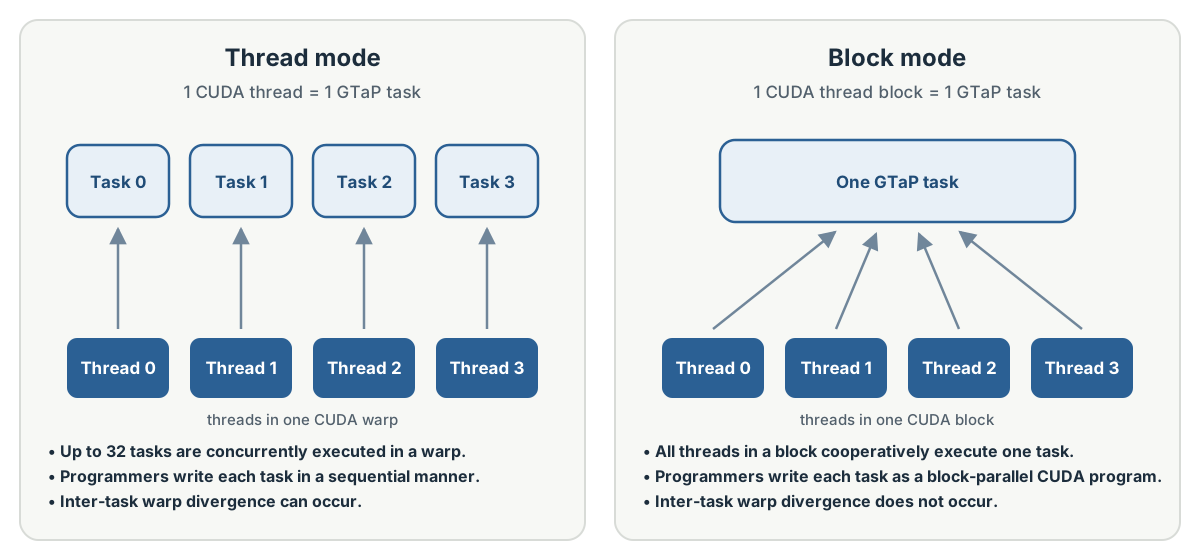
Choose the mode based on the work performed inside one task. Start with thread mode for sequential task bodies; use block mode when the threads of a CUDA block need to cooperate within each task.
Adaptive integration in both modes
The following two programs express the same adaptive numerical integration algorithm. Each task estimates the integral over an interval. If the estimate is not accurate enough, it spawns tasks for the left and right halves and joins their results.
The helper trap(a, b) evaluates one trapezoid sequentially. In the block-mode version, block_trap(a, b, n) distributes n trapezoids across the threads of the block and broadcasts their sum.
Thread-mode version
Each integration task runs sequentially on one CUDA thread. A CUDA warp can therefore execute up to 32 integration tasks concurrently:
#include "gtap_thread.cuh"

__device__ double d_result;

#pragma gtap function
__device__ double integrate(double a, double b) {
    double m = 0.5 * (a + b);
    double coarse = trap(a, b);
    double fine = trap(a, m) + trap(m, b);

    if (fabs(fine - coarse) < EPS)
        return (4.0 * fine - coarse) / 3.0;

    double left, right;

    #pragma gtap task
    left = integrate(a, m);

    #pragma gtap task
    right = integrate(m, b);

    #pragma gtap taskwait
    return left + right;
}

__global__ void exec_kernel(double lo, double hi) {
    #pragma gtap entry
    d_result = integrate(lo, hi);
}Block-mode version
Each integration task uses an entire CUDA thread block. The block cooperates inside block_trap, while only thread 0 spawns the two child tasks:
#define GTAP_BLOCK_SIZE 256
#include "gtap_block.cuh"

__device__ double d_result[GTAP_BLOCK_SIZE];

#pragma gtap function
__device__ double integrate(double a, double b) {
    constexpr int NTRAP = 256;
    double coarse = block_trap(a, b, NTRAP);
    double fine = block_trap(a, b, 2 * NTRAP);

    if (fabs(fine - coarse) < EPS)
        return (4.0 * fine - coarse) / 3.0;

    double m = 0.5 * (a + b);
    double left = 0.0, right = 0.0;

    if (threadIdx.x == 0) {
        #pragma gtap task
        left = integrate(a, m);

        #pragma gtap task
        right = integrate(m, b);
    }

    #pragma gtap taskwait
    return left + right;
}

__global__ void exec_kernel(double lo, double hi) {
    #pragma gtap entry
    d_result[threadIdx.x] = integrate(lo, hi);
}The fork-join structure is the same, but its CUDA execution differs:
| Aspect | Thread mode | Block mode |
|---|---|---|
| Work inside one task | trap runs sequentially | block_trap runs cooperatively across the block |
| Spawning one child | The task's thread executes task | The thread that reaches the task pragma—thread 0 in this example—spawns the child |
| Waiting | The task's thread reaches taskwait | Every thread in the block must reach taskwait |
| Child result in this example | Stored in left and right | Only thread 0 receives left and right |
Thread mode
In thread mode, each GTaP task runs on one CUDA thread. Task functions can therefore be written like ordinary sequential device code.
Include the thread-mode runtime:
#include "gtap_thread.cuh"Thread mode is a natural fit when:
- each task contains relatively fine-grained work
- the task body is mostly sequential
- the application creates many recursive or irregular tasks
Divergence-aware queueing
Different thread-mode tasks may execute in the lanes of the same CUDA warp. If those tasks follow different control-flow paths, warp divergence serializes their paths and reduces utilization.
Divergence-aware queueing (DAQ) lets the program classify tasks by their expected control flow. Configure more than one queue with num_queues, then use queue(expr) when spawning a child:
#pragma gtap task queue(child_kind)
result = visit(child);The same clause on taskwait selects the queue used when the suspended continuation becomes runnable:
#pragma gtap taskwait queue(continuation_kind)The expression must produce a queue index in [0, num_queues). Queue selection is a performance hint: program results and correctness must not depend on the selected queue.
See the Pragma Reference for the exact clause syntax and the Configuration Reference for num_queues and queue-capacity rules.
Block mode
In block mode, each GTaP task runs cooperatively on all threads in one CUDA thread block. A task body can use threadIdx, shared memory, block-wide synchronization, and familiar CUDA data-parallel patterns.
Define the CUDA thread-block size before including the block-mode runtime:
#define GTAP_BLOCK_SIZE 256
#include "gtap_block.cuh"Block mode is useful when each task contains substantial data-parallel work, such as shared-memory staging, cooperative graph processing, or parallel work over a task-owned region.
Why spawning is per-thread
In block mode, each thread that reaches #pragma gtap task spawns one child. The directive is intentionally per-thread rather than collective so that block-parallel work can generate multiple child tasks concurrently.
The block-mode asynchronous BFS example distributes a vertex's outgoing edges across the block. Every thread that discovers an unvisited neighbor spawns a separate task:
#pragma gtap function
__device__ void bfs(int v) {
    int dv = g_depth[v];
    int row_start = g_row_offsets[v];
    int row_end = g_row_offsets[v + 1];

    for (int e = row_start + threadIdx.x;
         e < row_end;
         e += blockDim.x) {
        int u = g_col_indices[e];
        int old = atomicMin(&g_depth[u], dv + 1);

        if (old > dv + 1) {
            #pragma gtap task
            bfs(u);
        }
    }
}One parent block can therefore spawn multiple BFS tasks in parallel. When a program instead needs exactly one child, guard the spawn with a designated thread, as in the integration example above.